
Nassau Scheduled and Actual Dates
NCSO's current-custody inquiry labels one field “Scheduled Release Date.” It may show a date and time or remain blank. The label belongs to a live county booking. It is an operational projection, not proof that the person walked out. A blank field does not mean a life sentence or permanent custody. Many pretrial cases turn on bond, a judge's order, and any other hold rather than a fixed sentence-expiration date.
Florida state prison uses a different framework. The FDC public detail can show “Current Release Date,” while Florida law calls the gain-time projection a “tentative release date.” Section 944.275 also requires a maximum sentence expiration date. Those labels should never be merged with Nassau's jail field. Actual release is the later executed event recorded by the custodian.
Release from one custodian may still lead to another. A transfer to FDC, another jail, federal authority, or ICE is not a return to the community. The destination field matters as much as the date.
Find Nassau Projected Release Dates
Start by identifying who has custody. Nassau County Jail information and FDC state-prison information use different records and rules. The court file supplies the sentence, bond order, credit language, and later modifications, while the custodian calculates and carries out release.
- Check the NCSO current-custody inquiry. If matched, read the scheduled field as of the access time, not as a completed event.
- For a Nassau jail sentence, review the signed judgment through the Nassau Clerk records gateway. Note the term, jail credit, and concurrent or consecutive instructions.
- Call NCSO booking at (904) 548-4006 about the live local computation and other holds. Request the actual release record after the event.
- For a Florida state prisoner, search the exact six-character DC number in the FDC Offender Search. Match the identity and read the current release field.
- When a state date or status seems wrong, contact FDC Central Records at (850) 488-9859 and record the date of the check.
The FDC inmate-release focused search is built for state correctional records.
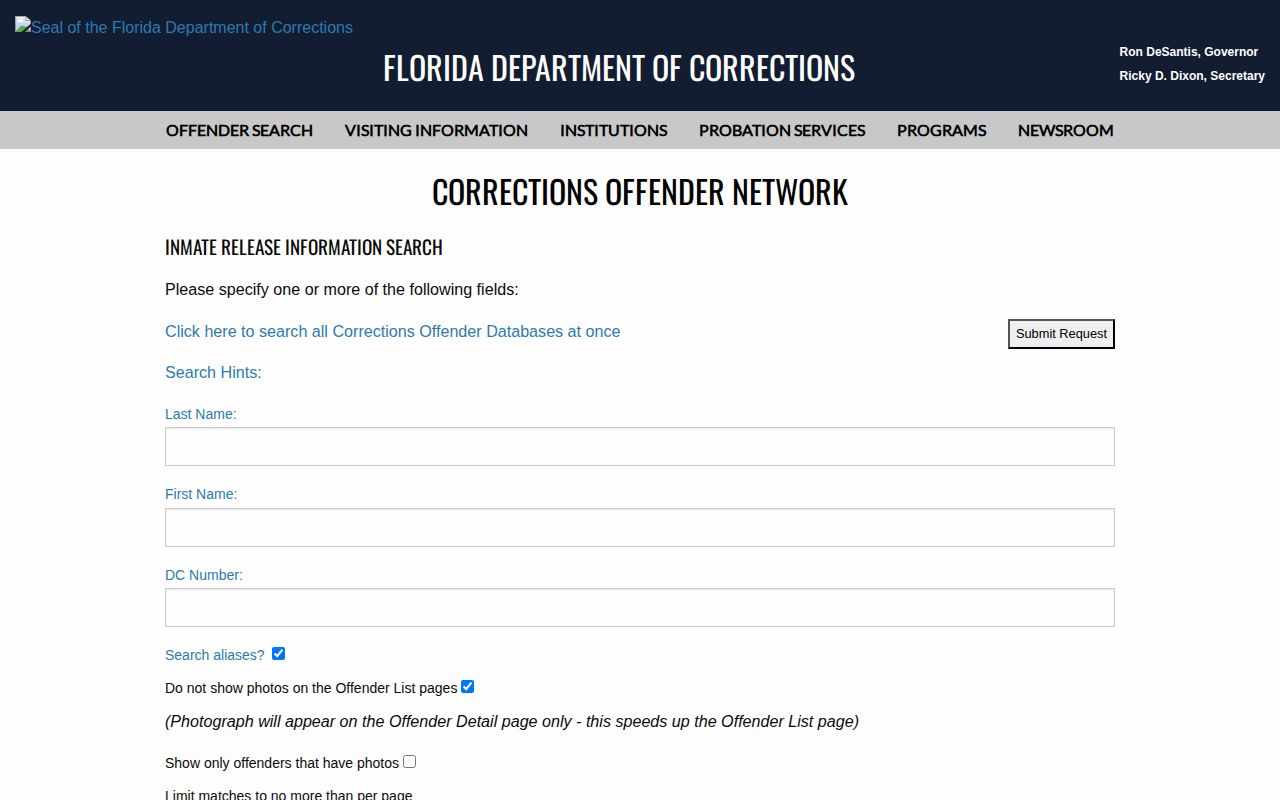
That search does not include a person who only served time in the Nassau County jail or remained on county probation.
Note: Record an “as of” date with every projected release result because the custodian can revise the calculation after the lookup.
Nassau FDC Release Date Labels
FDC identifies a state offender by DC number and permits name-prefix searches with aliases. A current-inmate detail may display “Current Release Date,” “TO BE SET,” or “SENTENCED TO LIFE.” A released detail instead uses “Release Date” and can show in-custody and out-of-custody history. These exact words prevent a projection from being reported as a past event.
FDC warns that public location, status, and release information can change fast and may not reflect the true current facts. Match more than a name. Compare the DC number, photograph when available, offense and sentence details, and case history. The public record can show state custody ended on a date, yet later supervision may remain active.
An official FDC detail example demonstrates the “Current Release Date” label.
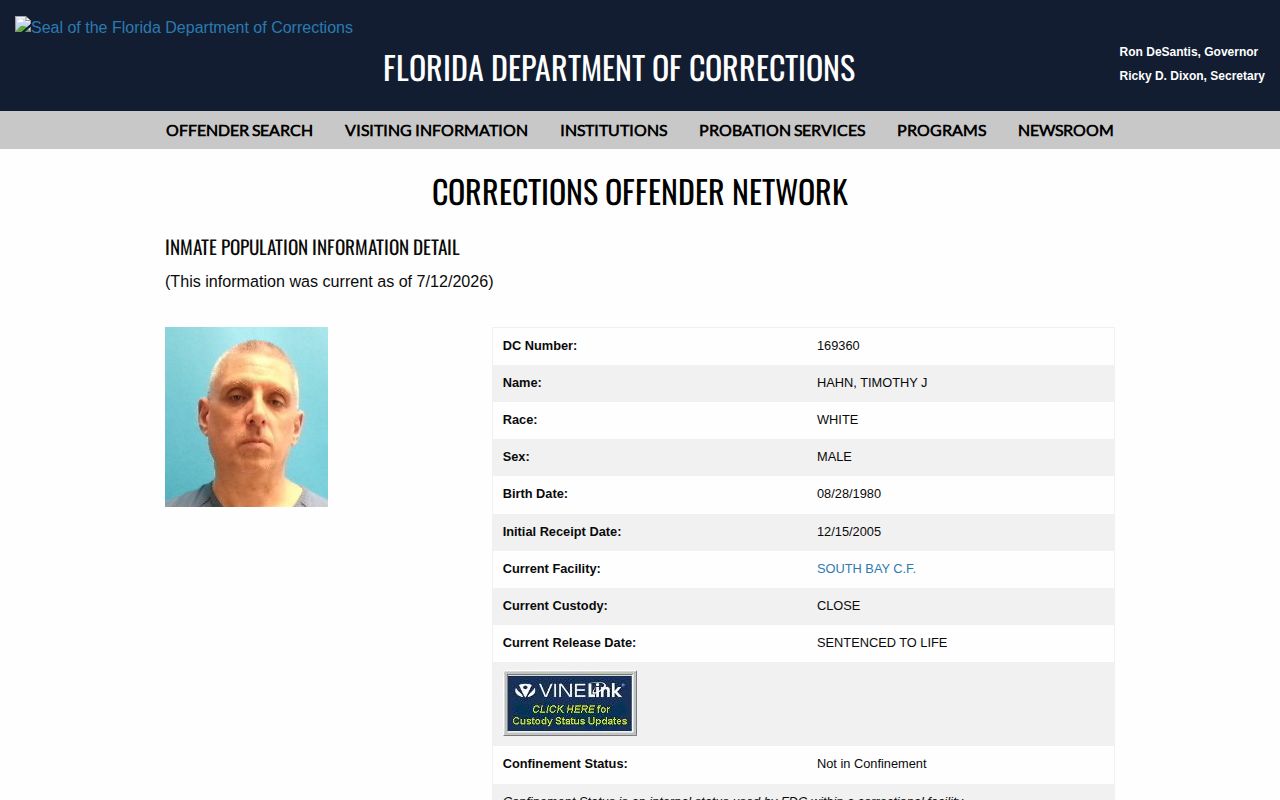
The display illustrates the public label only. It does not calculate a Nassau county-jail sentence.
Nassau State Gain-Time Rules
Florida's state-prison calculation begins with the imposed term or combined terms and lawful credit. FDC establishes a maximum sentence expiration. The initial tentative release date reflects the gain-time rules that apply to the offense date. Later awards or restoration may move it earlier, while forfeiture can move it later. Sentence structure, mandatory minimums, additional terms, escape and return, and parole violations can also affect the result.
For eligible offenses committed on or after October 1, 1995, Florida Statutes § 944.275 permits up to ten days per month of incentive gain-time but bars awards that would cause release before service of 85 percent of the imposed sentence. Court-awarded credit for physical incarceration counts toward that floor. Some offenses have added exclusions, older offense dates follow other regimes, and life sentences remain life absent pardon or clemency.
The statute itself is visible in the official tentative-release-date and gain-time source.
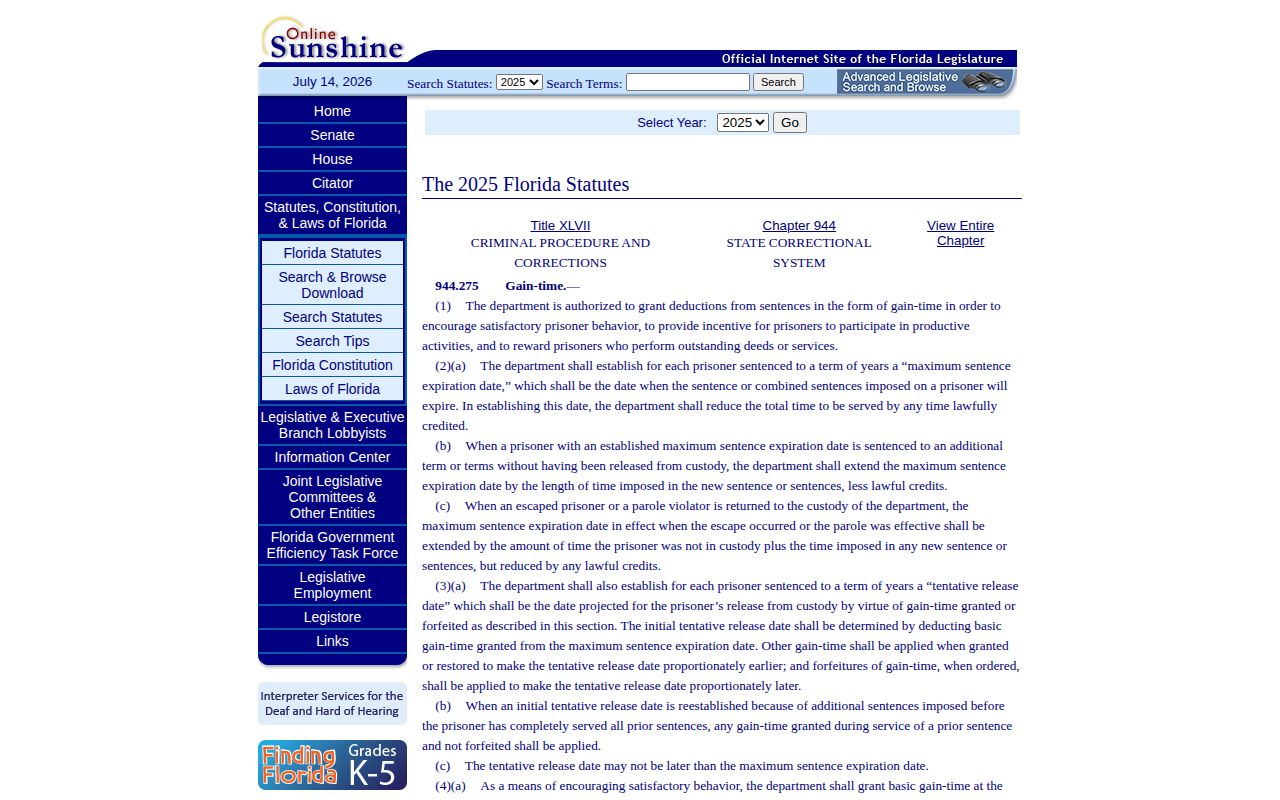
The law shows why a simple multiplication is not a reliable person-specific release calculator.
Nassau Jail Date Computation
A county sentence starts with the signed Nassau judgment. The relevant facts include the term, the date it begins, credit for time served, and whether several terms run at the same time or one after another. “Concurrent” means terms run together. “Consecutive” means one follows the other. Florida Statutes § 921.161 addresses credit for time served, but the custodian applies the actual computation.
FDC's prison gain-time plan does not automatically apply to a sentence served only at the Nassau County Jail & Detention Center. The research found no sourced Nassau rule that supports promising a set local gain-time award. Do not apply the state 85 percent floor to a county term. Ask booking about the scheduled field, inspect the judgment, and obtain the completed event after release.
- Scheduled date
- NCSO's current-booking projection, which may change or be blank.
- Tentative date
- FDC's statutory state-prison projection after applicable gain-time.
- Maximum expiration
- The state sentence end after lawful credit, before the tentative calculation is treated as actual.
- Actual release
- The event the custodian carried out, including the destination or receiving agency.
This county-state split is the core computation quirk for Nassau. It prevents a state formula from being used on a local booking and keeps a displayed date from being mistaken for completed release.
Nassau Release Date Changes
A date can move for a lawful reason or because the public data are still under review. Some factors apply mainly to county custody, some to FDC custody, and some to both. The latest custodian record controls over an older screenshot.
| Change | Effect on the date | Where to verify |
|---|---|---|
| Bond or court order | May create or revise a Nassau release path. | Nassau docket and NCSO booking. |
| Detainer or warrant | May delay community release or cause a transfer. | Custodian and receiving agency. |
| Corrected jail credit | Can revise the sentence computation. | Signed court record and custodian. |
| Gain-time award or restoration | May move an eligible FDC tentative date earlier. | FDC record and Central Records. |
| Disciplinary forfeiture | May move an FDC date later. | FDC institutional record. |
| New or restructured sentence | Can alter concurrent or consecutive terms. | Court judgment and FDC or NCSO. |
| Custody transfer | Ends one roster entry without ending custody. | Release destination and receiving locator. |
A presumptive parole date also differs from an effective parole date and actual release. Florida parole is largely a legacy process, and many current prison releases are sentence expiration, conditional release, or a prison term followed by probation. Read the specific FCOR and FDC records instead of labeling every release “parole.”
Note: A new order, hold, or data correction can change the date even when an older public screen still shows the prior value.
Confirm Nassau Actual Release
For a county booking, call NCSO and request the actual date, time, release method, and destination. Then compare the Nassau Clerk docket for the order or judgment that authorized the event. The live roster cannot confirm a past release because NCSO removes released arrestees from public results.
Documentary confirmation can be requested through the NCSO public-records portal. Include the booking number and ask for the actual release date, time, method, and destination.
For a state prisoner, check FDC again after the projected date and read the release history and any active supervising office. A release from prison does not by itself mean sentence discharge. Probation, conditional release, or another form of community supervision may remain.
A pending event may also be monitored through the Nassau County VINE inmate check. Treat its alert as notice to verify, since an agency feed can lag and a movement may be a transfer. The best confirmation pairs the completed custodian event with the legal or receiving record that explains it.
Nassau Sentence Date Records
The Nassau Clerk's criminal file explains where a release calculation begins. Circuit Court handles felony cases, while County Court handles misdemeanors and criminal traffic. A useful file may contain the judgment and sentence, jail-credit language, an order that terms run concurrently or consecutively, bond changes, probation terms, or a later revocation. The docket supplies legal authority, but it usually does not provide the moment NCSO finished identity checks, property reconciliation, and release processing. Pair it with the custodian event.
For an FDC sentence, the Nassau judgment establishes the term and FDC performs the state computation. If incarceration is followed by probation, the prison release date is not the end of the full sentence. The supervised-population search and listed Community Corrections office show whether post-prison supervision remains. Office 044 in Yulee serves the local FDC supervision path, but it publishes no general walk-in hours. Call the assigned office for a current status rather than inferring discharge from an old prison date.
Older parole-eligible sentences add another distinction. A presumptive parole release date is a proposed point in the FCOR process, while an effective date is a later legal step. Neither substitutes for the FDC actual release event. Modern Florida prison exits should not be labeled parole without the matched sentence and FCOR record. Conditional release under § 947.1405 is a separate statutory supervision plan for qualifying prisoners and can begin when prison custody ends.
When a public date conflicts with a signed order, call the agency doing the computation and identify the exact field, access date, DC or booking number, and court case. FDC Central Records handles a state-prison discrepancy. NCSO booking handles the live county calculation, and NCSO Records supplies the later event. This route preserves the difference between correcting a projection and proving an actual release.
Keep the response with the access date so a later revision can be compared to the prior projection.