
Nassau County Mugshot Records
A mugshot is a booking photograph made as part of an arrest and intake record. It documents how a person appeared during that booking. It does not establish guilt, explain why custody later ended, prove a present legal status, or show that the person remains in jail. The release event, court disposition, and photograph answer different questions.
Florida public-records law broadly covers existing state, county, and municipal records, subject to exemptions. NCSO provides an arrest-and-mugshot request route, which supports treating a Nassau booking photograph as a requestable sheriff record unless a specific restriction applies. Juvenile material, protected victim information, medical data, sealed or expunged files, and active investigative information can limit access. The agency must assess the actual record.
A photo can persist in an official file after the public roster stops showing it. That is because Nassau’s online visibility rule and its underlying record retention are not the same. A missing roster image should lead to an NCSO request, not a claim that the booking never occurred.
Nassau County Mugshot Channels
Several channels may display or supply a photograph, but each has a different scope. The county-jail image belongs to NCSO. A state-offender photo belongs to FDC and may depict the person at another time. A registry photo exists only for the specialized population covered by registration law.
| Channel | Photo availability | How to use it |
|---|---|---|
| NCSO current inquiry | Yes, for a currently listed detainee | Save the booking number and source before release; the person disappears afterward. |
| NCSO Records or Public Affairs | Available by request when public | Identify the exact booking and request the electronic booking image. |
| Official sheriff app | May mirror a current-inmate feature | Use only when operational; no released-photo archive is promised. |
| FDC Offender Search | Commonly shown on state-offender details | Use for a Florida prison or FDC supervision record, not a county-only booking. |
| FDLE registry | Yes for qualifying registrants | Read as a specialized registration record, not a general mugshot search. |
| Official news releases | Sometimes | Coverage is selective and may concern an allegation before final disposition. |
| Local news or third-party copies | Sometimes | Treat as a lead only; confirm identity, booking, and later case outcome officially. |
VINELink is primarily a custody-status and notification service. A live matched record may contain agency-supplied identifying information, but no official Nassau source promises it as a released-mugshot archive. Do not rely on an expected photo field that is absent from the live interface.
Note: A photo from another custodian may identify the same person yet belong to a separate booking or correctional event.
Current Nassau County Booking Photos
The NCSO current-custody inquiry displays photos in the list and booking detail for people it presently reports in custody. The detail can also show name, subject or booking number, reported jail location, scheduled release date, charges, bond, and court data. Capture the booking number and source URL before an expected release if the image must later be requested.
The official inquiry demonstrates the current-only rule and the entry point to booking details.
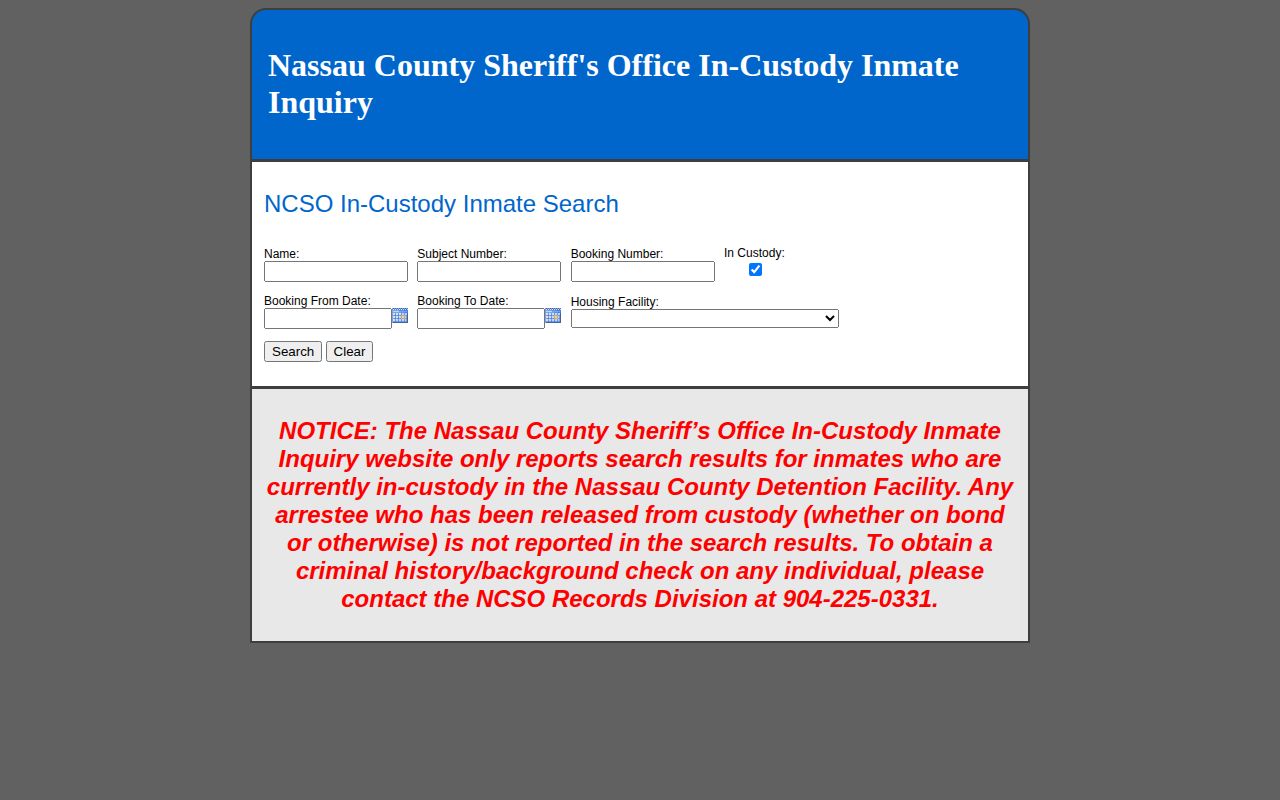
Once NCSO custody ends, the entire subject is excluded under the portal notice. It is not a released-photo archive, and its booking-date filters cannot restore a departed record.
The Nassau County 24-Hour Releases route explains the same-day records chain after that disappearance. The Nassau County released-inmate search adds court, VINE, state, federal, and transfer checks for a named person.
Note: A scheduled release date is a projection and does not prove that the pictured person left custody on that date.
Requesting Nassau County Booking Photos
The authoritative fallback for a Nassau jail image is NCSO. Use the JustFOIA public portal, call Records at (904) 548-4009, or visit Records at 77151 Citizens Circle in Yulee on weekdays from 8:00 a.m. to 5:00 p.m., excluding holidays. NCSO Public Affairs also provides a dedicated arrest-and-mugshot public-records request route.
- Identify the person by full committed name and aliases if known. Add date of birth only when needed to separate people with similar names.
- Provide the NCSO subject number or booking number and an approximate arrest or booking date. Include the case number if available.
- Ask for the booking photograph tied to that exact booking. Request electronic delivery and identify the desired image format only if necessary.
- If release context also matters, request the actual release date and time, method, destination, and bond or hold disposition as separate fields.
- Ask for an estimate before chargeable special-service work and request the nonexempt remainder if part of the record is withheld.
NCSO’s schedule lists ordinary paper and media charges, and it may assess special-service work when extensive review, redaction, technical resources, or clerical effort is required. It publishes no separate flat price for a booking photo and no guaranteed delivery time. An electronic image may avoid paper-copy charges, but an estimate remains the safe approach.
Florida Statutes § 119.07 requires reasonable efforts to locate records, production of nonexempt portions, and a statutory basis for withheld material. The law concerns existing records. It does not require staff to create a new portrait, explain the case, or decide what the photo proves.
Note: Ask for the booking image electronically and request an estimate because NCSO publishes no separate flat booking-photo price.
Nassau County Official News Photos
NCSO Public Affairs publishes selected news and offers the agency’s arrest-and-mugshot request path. An agency release may contain an arrest photo for a case chosen for public communication. Fernandina Beach Police Department news may also cover selected municipal arrests before transport to the county jail.
Official news is not a complete release list. It may describe allegations at an early stage and may never be updated with the final court outcome. Read the Nassau Clerk case record for disposition and NCSO’s release event for the end of county custody. The photo itself cannot fill those gaps.
Local outlets in Nassau County and the Jacksonville area may also publish arrest images for newsworthy matters. Such coverage is selective and copyrighted. Link to the reporting when relevant rather than copying the image without permission. A news photo may be the outlet’s own work or an agency-supplied booking image, so the caption and source matter.
Nassau County State-Offender Photos
The Florida Department of Corrections Offender Search commonly displays a photograph on a state-offender detail. It is appropriate when a Nassau case resulted in Florida state prison or FDC supervision. FDC expressly excludes county jail, county probation, and other local supervision, so a person who only bonded out of Nassau County Jail may have no FDC record.
Match a state record by the six-character DC number when possible. Otherwise use name prefixes and aliases, then compare descriptors, offense and case details, custody history, and photograph. A photo on an FDC detail is not necessarily the Nassau jail booking image. It also does not prove current custody or show the person’s present appearance.
The official FDC released-offender example illustrates how a state photo can remain with release history.
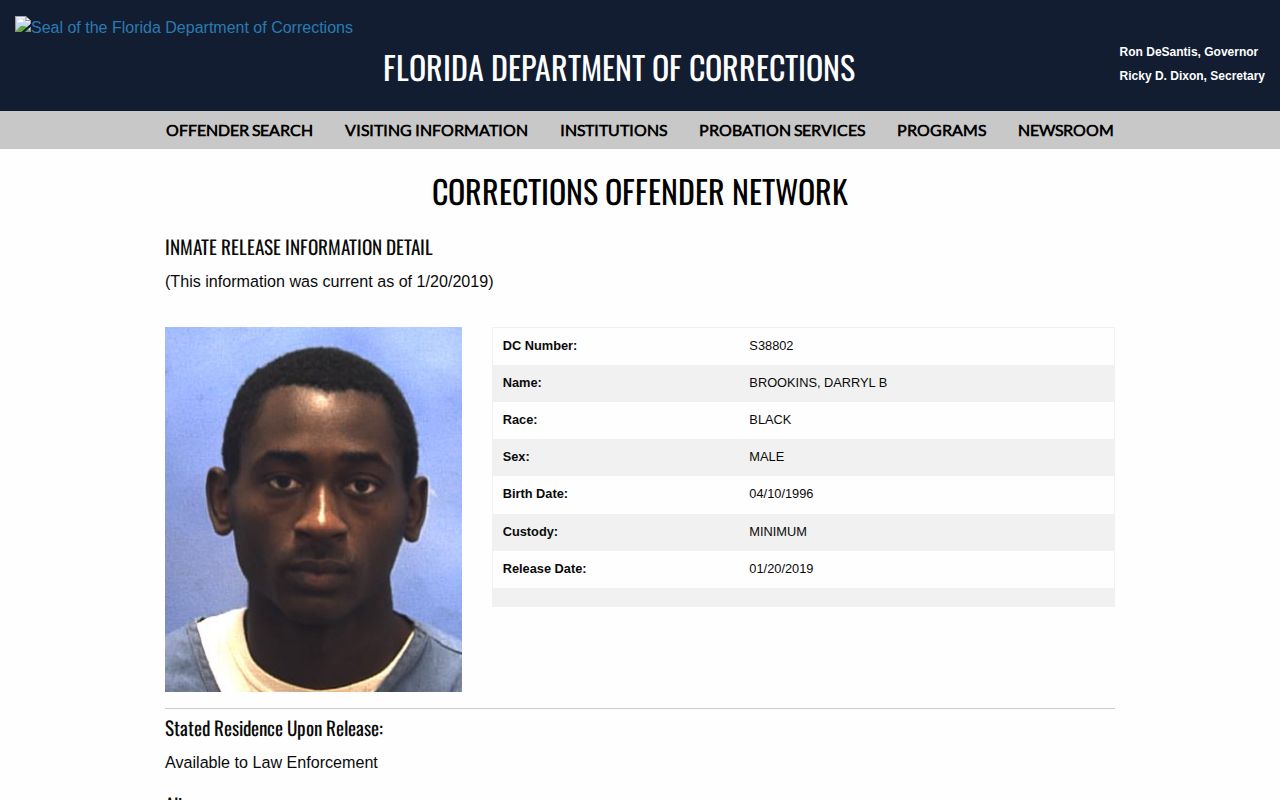
The state detail proves FDC’s format, not a county-jail release. Use NCSO for the Nassau booking photo and FDC for the state correctional image.
Nassau County Registry Photo Limits
The FDLE Sexual Offender and Predator Registry can show photographs, identifying data, addresses or status, and registration details for qualifying registrants. It is a specialized legal registry. It is not a directory of all people released from Nassau County custody.
One status, “Released - Subject to Registration,” has a narrow meaning: the person is no longer confined or supervised while still required to register. Other registry statuses can describe a person who remains confined or supervised. Read the record exactly and report an inaccuracy to FDLE through its published correction channel.
A registry photo may come from a different event or time than the NCSO booking at issue. Use it to verify the specialized registry record, not to substitute for the requested county photograph.
Note: Registry status and county release status answer different questions, even when both official systems display a photograph.
Nassau Sheriff App Photo Limits
The official Nassau County Sheriff (FL) app has included an inmate-search module, but its store description does not advertise released-person results or a photo archive. An April 2026 iOS review said that module had been temporarily disabled. That review is a dated user report rather than permanent agency policy. It still illustrates why a mobile feature must not be the only photo source.
The official NCSO app listing identifies the app and its outreach functions.
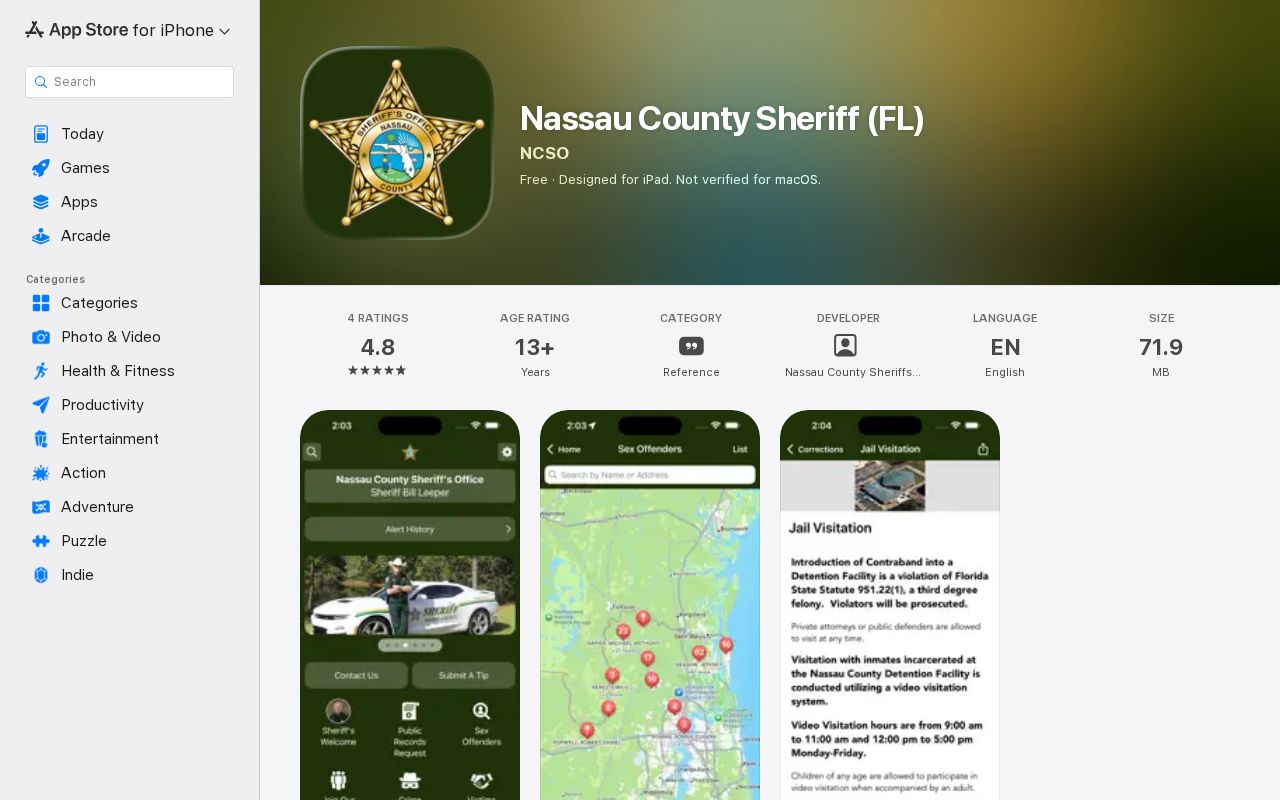
If inmate search is unavailable, use the live sheriff inquiry for a currently held person and the NCSO records request for a released person. The website’s current-only notice controls the public visibility question.
Nassau County Unofficial Photo Copies
Third-party aggregators may preserve a photo that was public during booking. They may also omit a later dismissal, confuse people with similar names, use an old image, or continue showing stale custody text. Treat such a copy only as a lead. No commercial mugshot publisher or data-broker link is needed when official county and state channels exist.
Local news can provide context, but it is not the custodian’s full record. Compare any copied image with the booking number, arrest date, agency, and official case. Never infer guilt, present custody, or release reason from the photo or caption alone.
- Booking photograph
- An image created during arrest processing.
- Release record
- The custodian’s event showing how and when custody ended.
- Disposition
- The court or agency outcome attached to the case or booking.
- Expungement
- A court-governed process that changes official access under Florida law.
Note: Linking to a lawful news report is different from reproducing its copyrighted image; source and permission still control reuse.
Nassau County Mugshot Removal Law
Florida Statutes § 901.43 addresses covered commercial publishers or disseminators of arrest booking photographs. A pictured person or legal representative can send a written removal request to the publisher’s registered agent. The statute generally requires a covered publisher to remove the image without charge within ten calendar days and bars republication or redissemination, with civil remedies described in the law.
The statute has defined scope. It does not command every government office or bona fide news publisher to erase the source record. Removal from one commercial page does not seal the sheriff file, close the court case, or prove that all copies disappeared. Read the current statutory text and seek legal advice about a specific publisher or disputed response.
Sealing Nassau County Booking Records
Release, dismissal, and the passage of time do not automatically seal or expunge a Nassau County record. Eligibility depends on the case outcome, prior history, offense, and Florida procedure. The Nassau Clerk provides local materials, while the FDLE sealing and expungement process supplies current certificate guidance.
A court order can change official public access, subject to statutory exceptions. It does not mean the person was never booked, and it does not make an old third-party photo accurate. If the NCSO portal lacks a photo, the cause may simply be release under the current-only rule. It may also reflect a search mismatch, restricted access, or system conditions. Do not infer expungement from a blank result.
For an official image, ask the custodian to apply the actual access law and identify the basis for any denial or redaction. For a commercial copy, the Florida booking-photo statute and a sealing or expungement order address different legal issues. Keep those processes separate.