
Nassau Parole and Probation Differences
Probation is a court-ordered sentence served in the community under stated terms. It may be imposed without prison or may follow incarceration. Community control is a more restrictive, court-ordered form of supervision. Parole is release from a parole-eligible prison sentence under FCOR authority before the sentence fully expires. Florida parole now mainly concerns legacy sentence categories, so a modern prison exit should not automatically be called parole.
Conditional release is different again. Florida Statutes section 947.1405 creates a mandatory post-prison supervision mechanism for specified qualifying prisoners. FCOR sets its conditions through a panel, but it is not discretionary parole. A person may also leave FDC custody into probation that was ordered as part of the sentence. In every category, release from the cell can precede discharge from the full sentence.
| Category | How it begins | Primary record |
|---|---|---|
| Felony probation | Court sentence or post-prison term | FDC supervision detail and sentencing order |
| Community control | Court-ordered restrictive supervision | FDC detail and court order |
| Parole | FCOR action on a parole-eligible sentence | FCOR order and FDC status |
| Conditional release | Statutory post-prison program for qualifying cases | FCOR terms and FDC supervision record |
| County supervision | Local sentence, often misdemeanor | Nassau court record and local provider |
- Parole
- Conditional community release for a parole-eligible prison sentence under FCOR authority.
- Probation
- A court sentence served in the community under rules and reporting duties.
- Absconder
- A status that generally signals lost contact or noncompliance, not successful discharge.
- Discharge
- The formal end of a sentence or supervision obligation.
Verify Nassau Post-Release Supervision
Start with the FDC Corrections Offender Network menu. The regular offender search is limited to felony offenders sentenced to state prison or state supervision. It does not cover county jail, county probation, or every local supervision provider. Search with the six-character DC number when possible. A name search should be checked against aliases, photograph, physical descriptors, offense, case, and sentence information.
- Open the FDC supervised-population search and enter the DC number or matched name.
- Confirm identity through more than one field. Do not rely on a shared name.
- Read the supervision status, category, location, and office in the record's own terms.
- Check the Nassau sentencing docket for probation, community control, violation, revocation, or termination orders.
- Call the listed FDC Community Corrections office when a current answer matters.
The official FDC menu includes inmate, released, supervised-population, and absconder or fugitive paths. It shows why a prison release search and a supervision search answer different questions.
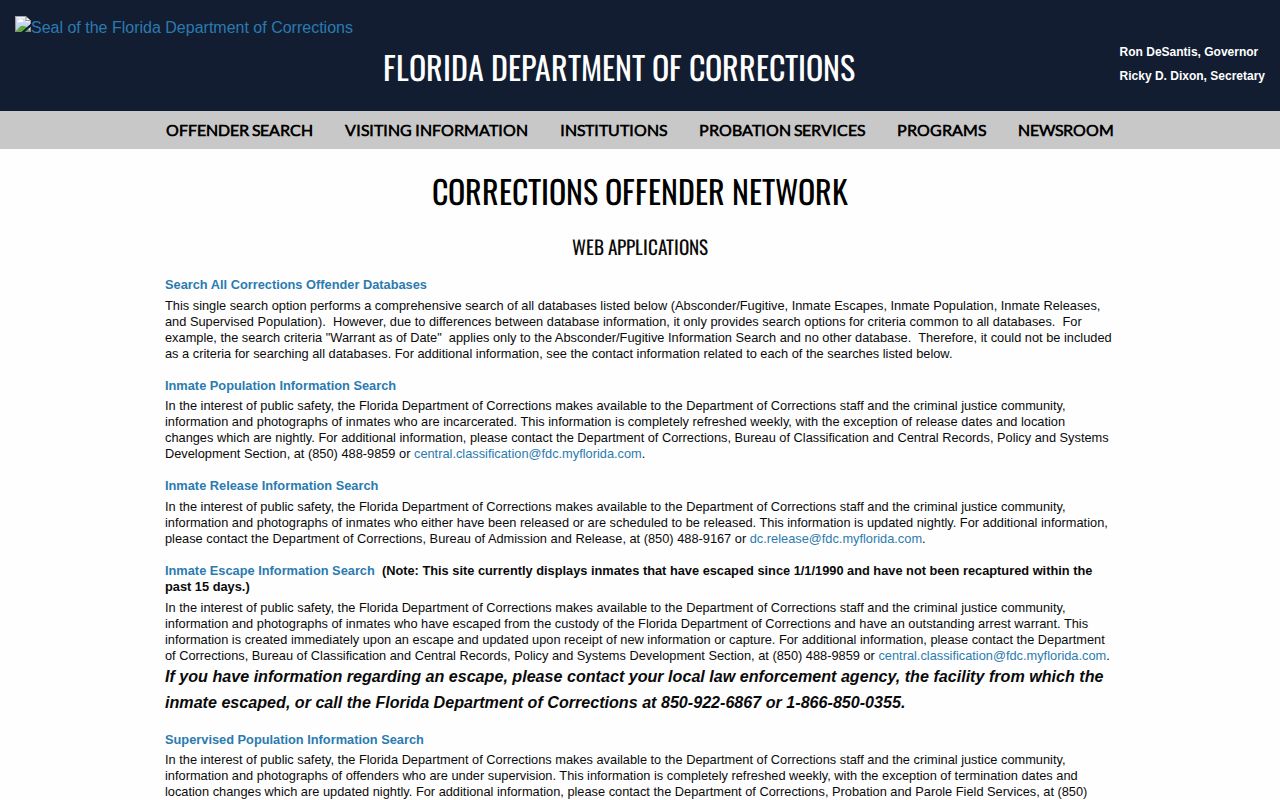
A released date is historical evidence that FDC prison custody ended. The supervised-population result and office contact determine whether an FDC term continued afterward.
Scope check: A Nassau misdemeanor probation term may require the clerk and local supervision provider because FDC expressly excludes county probation.
Nassau Supervision Office Records
FDC Office 044 in Yulee is the local Community Corrections office for Nassau. It belongs to the Jacksonville Circuit, which covers Clay, Duval, and Nassau counties. The office supervises court-ordered probation and community control as well as people released from prison with state post-release supervision. The directory does not publish walk-in reporting hours. Call the office or assigned officer before visiting.
FDC Office 044, Yulee
86058 Pages Dairy Road
Yulee, FL 32097
Phone: (904) 548-9380
Fax: (904) 548-9393
Hours: no public walk-in schedule listed
The official Jacksonville Circuit directory supplies the office listing. The captured page below helps connect the Nassau record to the proper local office.
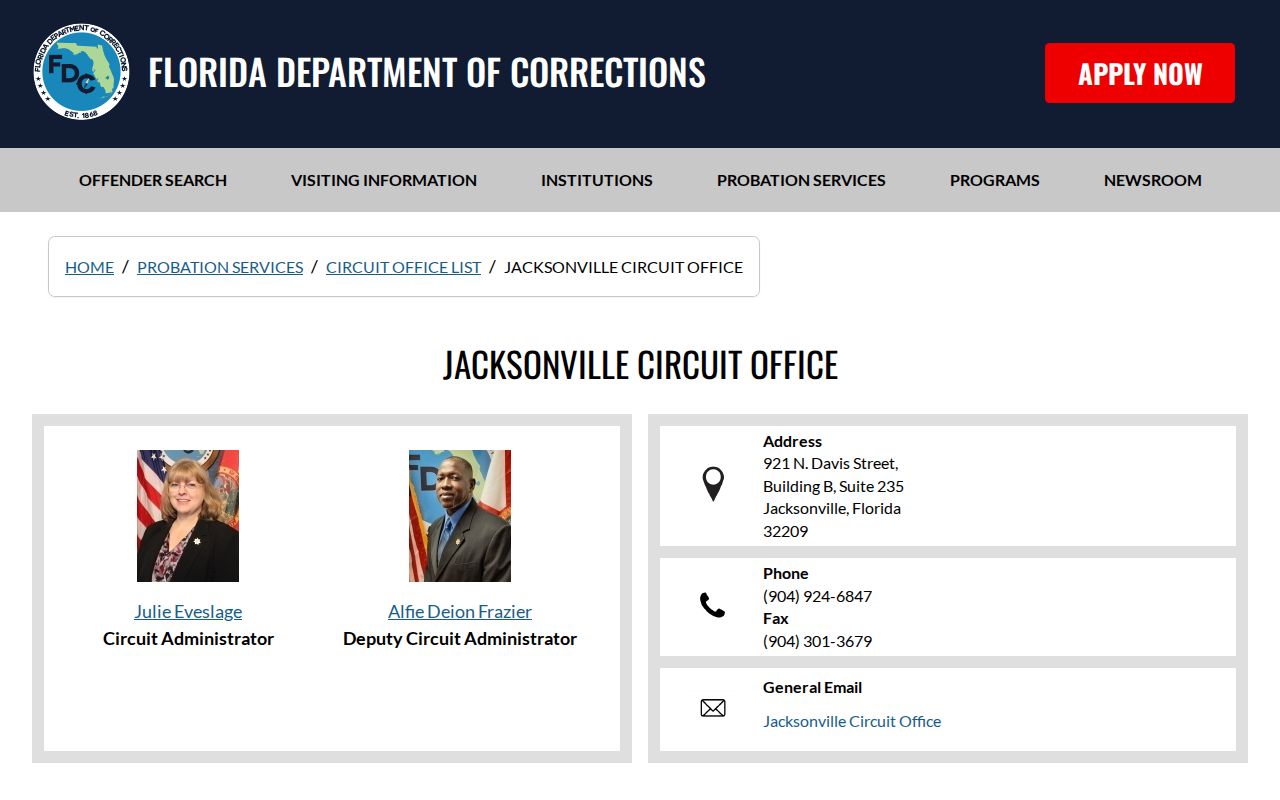
The office can verify its own current supervision information. It cannot turn a county misdemeanor record into an FDC case or certify a court order maintained by the clerk.
Note: Use the office shown on the matched FDC detail if it differs from Yulee, since supervision location can change.
Nassau Supervision Status and Absconders
FDC offers separate supervised-population and absconder or fugitive searches. An absconder status generally means the agency reports lost contact or noncompliance. It is not a discharge. It may be linked to warrant or revocation action, but the public label should not be expanded into an unsupported claim about a particular violation.
Verify a warrant through the issuing court or supervising agency. The Nassau Clerk Records Search may show an affidavit, violation filing, warrant, hearing, revocation, reinstatement, or termination order when public access permits. A VINE alert concerns custody status and movement, not every change in community supervision. FDC data also refreshes on different schedules: supervised and absconder records are described as weekly, while termination and location changes may update nightly. A time-sensitive result needs a call.
Conditions vary by the court order and supervision category. At a high level, they can involve reporting, approved travel, payments, treatment, testing, residence rules, or other person-specific terms. The signed order and assigned officer control. Do not infer a condition from another person's case.
Nassau Supervision Release Notifications
Florida VINE is a free custody and movement notification system for Florida county jails, FDC prisons, and the Department of Juvenile Justice. It does not report every probation-office change. For a Nassau jail record, select Florida and the Nassau County agency. For a state-prison record, select FDC. Match the person and agency before registering, since a shared name can attach an alert to the wrong record.
Direct VINE registration can use phone, text, or email options presented by the live service. Phone registration uses a four-digit PIN to acknowledge a call, and FDC's form says calls repeat until the PIN is entered. FDC Victim Services keeps a separate state notification database for events such as release, transfer, escape, death, and out-to-court movement. Direct VINE registration does not automatically create an FDC Victim Services registration, and updating one does not update the other.
The VINELink service and its 24-hour line at 1-877-846-3435 can help confirm or maintain an alert. FDC Victim Services is reached at 1-877-884-2846 on weekdays from 8:00 a.m. to 5:00 p.m. Eastern. A notification is a prompt to verify the event with the custodian. It is not a discharge order, and a release from one agency does not rule out another hold.
The FDLE Sexual Offender and Predator Registry is another narrow post-release channel. Its “Released, Subject to Registration” status means the registrant is no longer confined or supervised but still must register. It is not a list of all Nassau County released people and does not replace a custody or supervision check.
Note: Save registration details privately and update the contact method when it changes, but never publish the notification PIN.
Nassau Parole Hearing Records
The Florida Commission on Offender Review is the responsible parole board. Its Commission Voting Schedule is a rolling monthly calendar with several meeting dates in many months. A dated detailed agenda can list a DC number, category, county, offense, case number, and whether the matter is before a panel or the full group.
An agenda proves scheduling only. It is not a final decision. FCOR did not present a verified person-name database of final outcomes in the researched channels. Request the written order, vote or action sheet, presumptive or effective date decision, or revocation order by name, DC number, and hearing date through FCOR Public Records. Then corroborate any actual prison release through FDC.
Florida parole eligibility is sentence and offense-date specific. The main eligible group concerns older, legacy sentences, with narrow statutory exceptions. Sections 947.172 and 947.1745 distinguish a presumptive parole release date from an effective release date. Neither label proves that the release was executed. Conditions, rescission, later action, or another custodian can still affect the outcome.
Nassau Supervision Discharge Records
Supervision ends through a formal record, not by the passage of a prison release date. Florida Statutes section 947.24 addresses discharge from parole and release supervision. Probation or community-control termination may appear in the sentencing court docket and in FDC status when FDC administered the term. A completed term should be supported by the relevant termination or discharge entry.
A historical FDC release record may coexist with later supervision, a violation, a new sentence, or an older completed term. Read the whole state detail and compare case numbers. If the public status conflicts with a current order, contact the listed office and FDC Central Records. For a Nassau county sentence, use the clerk because the state search excludes county probation.
The broader Nassau County released inmate search covers the jail event, court authority, FDC release history, VINE, and records-request path when the question is custody rather than supervision alone.
Note: “Released” describes custody; “discharged” is the stronger term for a supervision obligation that has formally ended.
Nassau Release Reentry Services
NCSO Corrections lists several programs inside the Nassau County jail that may support preparation for release. They include GED preparation and testing, recovery groups, Parenting 101, InsideOut Dad, faith-based reentry mentoring, and chaplain services. These are documented local offerings, not guarantees that every person is eligible or that each program is active on a given date.
NCSO's 2022 annual report also described an Inmate State ID Card service supported by the Nassau Tax Collector and the Inmate Welfare Fund. A state ID can help with practical reentry tasks, but the dated source should be treated as a program record rather than a current promise. Ask NCSO about present access before relying on it. None of these services changes the terms set by a court, FDC, or FCOR.
Nassau Release Property and ID
NCSO inmate-processing information says property and money are reconciled through booking when a person is cleared for release. The sheriff publishes no deadline for unclaimed property and no specific correction process for an inaccurate release field. Booking is the direct route for a real-time closeout question. Records is the route for an existing document or field.
Property, identification, and supervision are separate tasks. Receiving personal items does not prove discharge. Taking part in an ID program does not establish the terms of release. After a state-prison exit, the matched FDC office and court or FCOR record remain the sources for supervision. After a Nassau jail release into local supervision, the sentencing order identifies which provider controls.