
Nassau Jail Release Destinations
The NCSO Division of Corrections operates the county adult jail. A community release can follow bond, recognizance, dismissal with a release order, time served, county-sentence expiration, or clearance of another hold. NCSO says the cleared person returns to booking, where staff reconcile property, money, bonds, and related matters. Release times vary. A judge's order or bond payment does not state when every booking step will finish.
Other departures remain custody. A person may transfer to the Florida Department of Corrections, another county jail, federal authority, ICE, a hospital, or another agency. Death also ends a custody entry but must be described with care. Because NCSO removes every released arrestee from its public inquiry, absence alone cannot separate these outcomes. The actual release disposition and destination are essential.
| Departure | What it means | Next record |
|---|---|---|
| Bond or court release | County detention ends, while the criminal case may continue. | NCSO event and Nassau Clerk docket. |
| Sentence completed | The county term ends after lawful computation and holds clear. | Judgment plus actual NCSO release. |
| FDC transfer | State custody begins or continues. | FDC offender detail. |
| Federal or ICE handoff | Nassau custody ends without community release. | Destination, federal case, BOP or ICE channel. |
Confirm Nassau Jail Releases
The NCSO current-custody inquiry is the first check only while the person remains held. Its list can show name, photograph, in-custody status, scheduled release date, booking history, and assigned facility. The notice is decisive: a person released on bond or by another route is not reported. Booking-date filters do not create a past-release search.
- Search the exact name, subject number, or booking number and note the access time.
- If matched, read the scheduled date as provisional. Do not report release as completed.
- If absent, call booking at (904) 548-4006 and ask whether that booking ended and whether the destination was community or another custodian.
- Review the Nassau Clerk case for the bond order, disposition, judgment, or commitment.
- Request the actual NCSO booking/release event when documentary proof is needed.
The official inquiry capture below illustrates the current-only entry point.
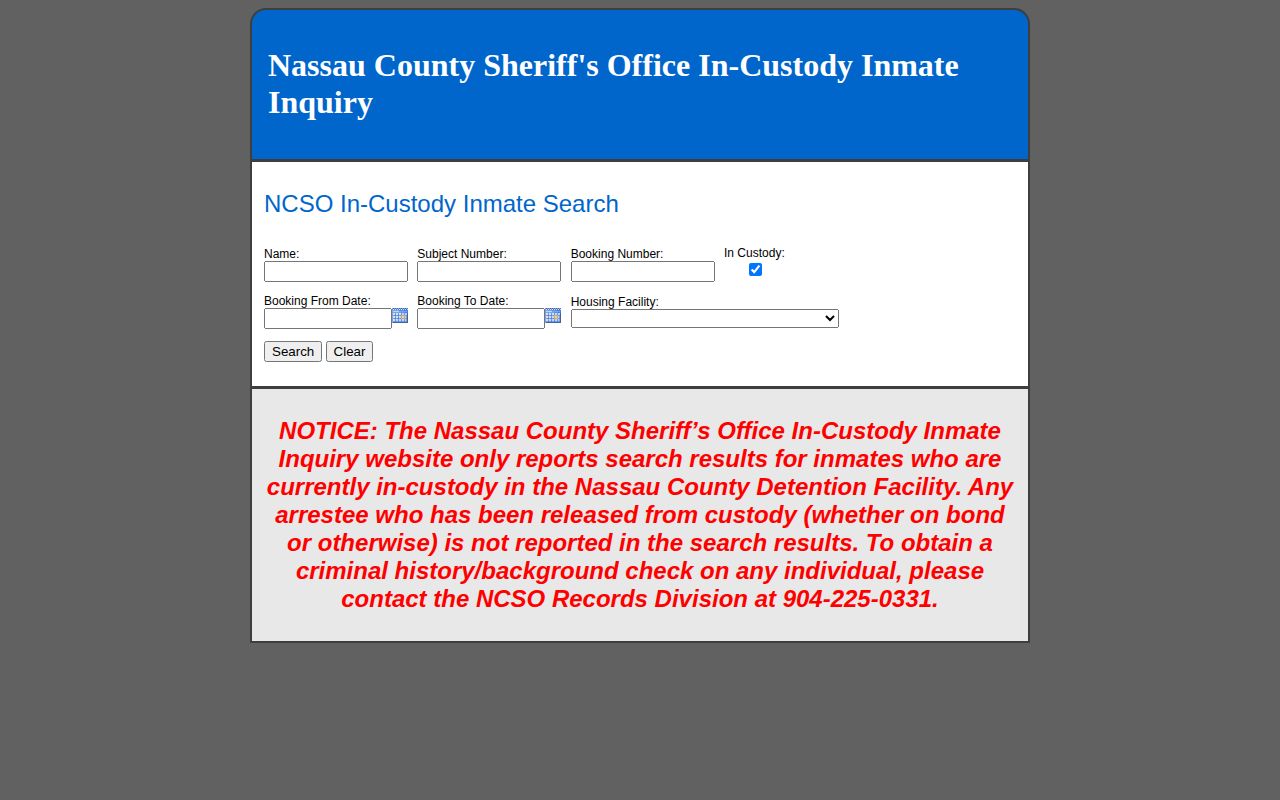
Once the subject disappears, the durable search shifts to booking, Records, the court, and any receiving agency. The broader Nassau County released inmate search explains those county, state, and federal paths.
Nassau Jail Release Contacts
Use the address and phone tied to the task. The detention building is not the same address as NCSO headquarters and Records. Call before travel because NCSO publishes no fixed release door, family waiting area, rideshare rule, clothing process, or unclaimed-property deadline.
76212 Nicholas Cutinha Road
Yulee, FL 32097
Jail information: (904) 548-4002
Booking, release, and bond: (904) 548-4006
For a record, contact NCSO Records at 77151 Citizens Circle, Yulee, FL 32097, (904) 548-4009. In-person hours are Monday through Friday, 8 a.m. to 5 p.m., excluding holidays. The JustFOIA portal accepts online requests. Ask for an electronic copy and an estimate before special-service work.
Note: Booking is the live operational channel, while Records supplies the later event that can document actual release and destination.
Nassau Jail Release Records
A focused request should name the person, booking or subject number, approximate booking date, and case number when known. Ask for existing fields: actual date and time custody ended, release type, destination or receiving agency, bond and hold disposition, related release order, and booking photograph. Agencies need not create a legal conclusion or custom narrative.
Florida's GS2 schedule describes booking records and Commitment and Release Lists as official record series. The applicable record-copy minimum can extend at least one anniversary year after release, subject to audit rules, while jail docket books are permanent. That does not prove NCSO creates every optional series or field. It supports asking whether a GS2 Item 22 list exists for the date.
NCSO's 2026 schedule lists letter copies at $0.15 per page, legal copies at $0.20, arrest reports at $0.15 per page, and certification at $1 plus copy charges. Extensive technical, clerical, redaction, or media work may bring a $22.81 hourly special-service charge. The agency provides a good-faith estimate rather than a fixed completion deadline.
Nassau Jail Custody Role
The county jail handles adult intake, identity clearance, classification, placement, property inventory, medical screening, release processing, and transfers. The portal calls the assigned facility “Nassau County Jail and Detention Center,” while its notice uses “Nassau County Detention Facility.” Both refer to the county custody path, not a state prison.
A bond release is still pretrial in most cases. NCSO says full cash bond at public reception uses a certified or cashier's check from a local bank, subject to verification, or a money order payable to the Nassau County Clerk. Cash and credit cards are not accepted for that route. A surety bond goes through a bonding agency, and deputies cannot recommend one. A civil-writ purge uses similar instruments payable to NCSO, which is a different payee.
Property and money are reconciled at release through booking. No published NCSO policy in the research supplies a deadline for unclaimed property or a correction procedure for an erroneous release record. Direct those questions to booking or Records rather than assuming a rule.
Nassau Jail ICE Transfers
A 2019 NCSO and ICE Warrant Service Officer agreement documents a local process in which scheduled release from criminal custody could become a transfer to ICE. That evidence shows why roster disappearance is not proof that the person entered the community. The agreement's date also matters. It supports the possible route, not a claim that every current case follows it.
Ask NCSO whether the release disposition says “to ICE” or names another receiving agency. Then use the ICE detainee locator and information line for the individual. A detainer is a request tied to immigration custody, not a criminal conviction or final immigration decision. A negative ICE search also does not prove freedom, removal, or location.
Nassau Jail Federal Transfers
Nassau County's financial report identifies a Sheriff Federal Inmate Fund tied to federal inmates held at the county jail. The physical building therefore does not always identify the legal custodian. In a federal matter, disappearance from NCSO may reflect a U.S. Marshals transfer, a BOP designation, a court release, or another handoff.
Request the destination from NCSO. A sentenced federal prisoner belongs in the BOP Inmate Locator, while many pretrial detainees require the federal case clerk or U.S. Marshals path. “Released” or “Not in BOP Custody” means BOP custody ended, but another agency or federal supervision may remain. Pair the federal status with the court record and release destination.
Note: Facility location alone cannot establish whether the Nassau County jail, USMS, BOP, or ICE controls the next custody step.