
Nassau Release Records Explained
A release is the end of one custodian's hold. It is not always the end of all custody or of the criminal case. The Nassau County Jail & Detention Center may release someone on bond, after time served, under a court order, or at the end of a county sentence. The jail may instead transfer that person to the Florida Department of Corrections, another jail, federal authorities, a hospital, or immigration custody. A transfer removes the name from Nassau's live inquiry, but it is not a return to the community.
No single document answers every release question. NCSO holds the booking and executed release event. The Nassau County Clerk holds the order, judgment, bond entry, sentence, or disposition that gave legal authority for the event. FDC holds state-prison and state-supervision records. VINE supplies status and notifications rather than a certified certificate. The record must therefore be matched to the agency that had custody at the time.
- Release
- Custody ends with one agency, either into the community or through a transfer.
- Time served
- A sentence is satisfied through time already spent in custody, as credited by the court and calculated by the custodian.
- Discharge
- A sentence or supervision term ends, which is broader than merely leaving a jail or prison.
- Detainer
- A request or legal basis for another agency to hold or take custody of a person.
Nassau Release Types and Transfers
The reason a person left the jail determines what to check next. A bond release ends pretrial detention, but the charge usually remains open. A dismissal or acquittal may support a court-ordered release, yet another hold can delay departure. Probation or community control allows a person to live outside a cell under stated rules. Parole and conditional release concern defined state-prison cases and should not be used as a label for every prison exit.
| Event | Meaning | Next record |
|---|---|---|
| Bond or recognizance | Pretrial jail custody ends while the case may continue. | NCSO release event and clerk docket |
| Time served or sentence complete | The county term and lawful credit have been applied. | Judgment, custody credit, and actual release event |
| Probation or community control | Custody may end while supervised terms remain. | Court order and the correct supervision office |
| State prison release | FDC custody ends, sometimes into supervision. | FDC released and supervised-population records |
| Agency transfer | Nassau custody ends but confinement continues elsewhere. | Destination field and receiving custodian |
Temporary movement for court or medical care is not a release. Escape is not a lawful discharge. Death ends custody but must be described with care and with the exact disposition. When the outcome matters, pair the custodian's event with the legal order or receiving-agency record.
Note: A transfer ends Nassau County jail custody but does not mean the person has entered the community.
Nassau Release Record Fields
A narrow request produces a more useful record. Identify the full committed name, known aliases, booking or subject number, arrest range, and case number. Ask for the actual release date and time, release method, destination or receiving agency, bond and hold disposition, and the release order or log entry tied to that booking. A booking photograph may be requested with the same identifiers. These are existing fields, not a request for NCSO to form a legal opinion.
| Field | What it shows |
|---|---|
| Booking or subject number | Connects the event to the correct jail record. |
| Actual release date and time | Shows when NCSO finished processing, if recorded. |
| Release method or type | Distinguishes bond, court order, sentence completion, or another event. |
| Destination or receiving agency | Separates community release from transfer. |
| Bond and hold entries | Shows the recorded status of bail and other custodial claims. |
| Property and money closeout | Documents reconciliation associated with release processing when maintained. |
The court file adds the legal context. It may show bond rulings, dismissal, judgment, sentence, custody credit, probation, a violation, or termination. A docket entry alone does not give the moment the jail opened the door. Compare it with the executed NCSO event.
Important: A scheduled release date on the live roster is a projection, not proof that the person left custody.
Nassau Release Records Requests
The NCSO public-records portal is the durable county fallback. Records also assists by telephone at (904) 548-4009 and in person at 77151 Citizens Circle in Yulee, Monday through Friday from 8:00 a.m. to 5:00 p.m., excluding holidays. A requester may ask for an electronic copy and for an estimate before chargeable work begins. NCSO publishes no guaranteed completion time.
- Match the person to a booking number, subject number, date range, or case number.
- Request the booking and release event, actual date and time, method, destination, holds, bond entries, and photograph needed.
- Ask for nonexempt portions if part of the record is withheld and request the statutory basis for each redaction.
- Approve the good-faith cost estimate only after checking that the scope matches the intended event.
Effective January 1, 2026, NCSO lists letter copies at $0.15 per page, legal copies at $0.20, CDs at $0.50, DVDs or Blu-ray discs at $2, and arrest or incident reports at $0.15 per page. Certification adds $1 plus the copy fee. Extensive work described by the agency can carry a $22.81 hourly special-service charge and may require a deposit. Florida law permits a request for existing records without giving a reason.
Note: Use the booking number when available because common names and repeat bookings can point to the wrong event.
Nassau Release Records Retention
The public roster's visibility ends when release occurs, but the underlying record does not vanish with the online result. Florida's GS2 schedule describes booking records, commitment and release lists, incarceration records, and jail docket books. Record copies for several booking and release series have a minimum retention of one anniversary year after release, subject to audit release, while jail docket books are permanent. The schedule defines possible series and fields; it does not prove NCSO creates every optional document.
Florida Constitution article I, section 24 and Florida Statutes section 119.07 govern access to nonexempt records. A custodian may redact protected content and must identify the exemption used. Active investigative material, protected victim information, juvenile and medical material, protected addresses, and sealed or expunged court material can limit access. Sealing or expungement follows a legal process and is not an automatic result of release or dismissal.
Can a missing roster result prove expungement? No. Nassau's inquiry removes every released arrestee by design. A missing result may reflect release, a spelling mismatch, access limits, or a system issue. The clerk and NCSO must confirm the applicable record.
Nassau Bond Release Steps
Nassau's bond instructions distinguish payment routes. For a full cash bond at jail reception, NCSO accepts a certified or cashier's check drawn on a local bank and subject to verification, or a money order payable to the Nassau County Clerk of Courts. Cash and credit cards are not accepted for that route. A licensed bonding agency may post a surety bond, but deputies cannot recommend an agency.
A civil writ purge uses a different payee: a certified or cashier's check or money order payable to NCSO. Mixing the payees can delay processing. Bond posting also does not equal instant departure. Staff still must verify the payment, check other holds, reconcile the booking, and finish release steps. Most important, bond ends detention but not the pending court case. The clerk docket remains the source for later hearings and disposition.
Nassau Jail Release Timing
NCSO publishes no fixed release hour. Its inmate-processing information says a cleared person returns to booking, where staff process property inventory, money, bonds, and related matters as quickly as possible. Release times vary. A judge's order, bond payment, or scheduled date can begin or forecast the process, but none proves the moment a person walks out.
The booking desk at (904) 548-4006 is the immediate source for a specific release or bond question. Ask whether the named booking has ended and whether the disposition was a community release or transfer. For proof later, request the actual event and destination from Records.
Note: Identity checks, paperwork, unresolved holds, and account reconciliation can separate legal clearance from physical departure.
Getting Home After Nassau Release
NCSO promises no ride and publishes no jail-gate bus stop. The Nassau Express Select commuter route boards at the Yulee Park & Ride at Lofton Square for weekday travel toward Jacksonville. It does not stop at the detention-center gate. County demand-response transit may have separate eligibility, reservation, and operating rules that need direct confirmation.
Families should confirm the actual release before travel and ask booking about any current pickup or waiting instructions. A projected time can move. Transportation should be arranged without assuming a bus, rideshare pickup point, waiting area, or release door that NCSO has not published.
Nassau Release Population Snapshot
FDC's April 2024 county-detention report recorded a Nassau Jail average daily population of 266. Of that one-month snapshot, 200 people, or 75.2 percent, were listed as pretrial detainees. The total included 171 felony-pretrial and 29 misdemeanor-pretrial detainees. These figures are not annual release counts, current capacity, or today's roster.
The dated figures give context for frequent booking and release activity. They do not create a recent-release feed. Each person's status still needs a person-level check through NCSO and the proper supporting record.
Note: This one-month population snapshot must never be presented as an annual release count or current jail census.
Find Nassau County Released Inmates
The NCSO In-Custody Inmate Inquiry is a starting point, not a released-person archive. It allows searches by name, subject number, booking number, in-custody status, booking-date range, and facility. The list can show a photo, name, status, scheduled release date, physical descriptors, multiple-bookings indicator, and assigned facility. Its decisive notice says a person released on bond or by any other route is not reported.
The official NCSO inquiry below demonstrates that current-custody boundary.
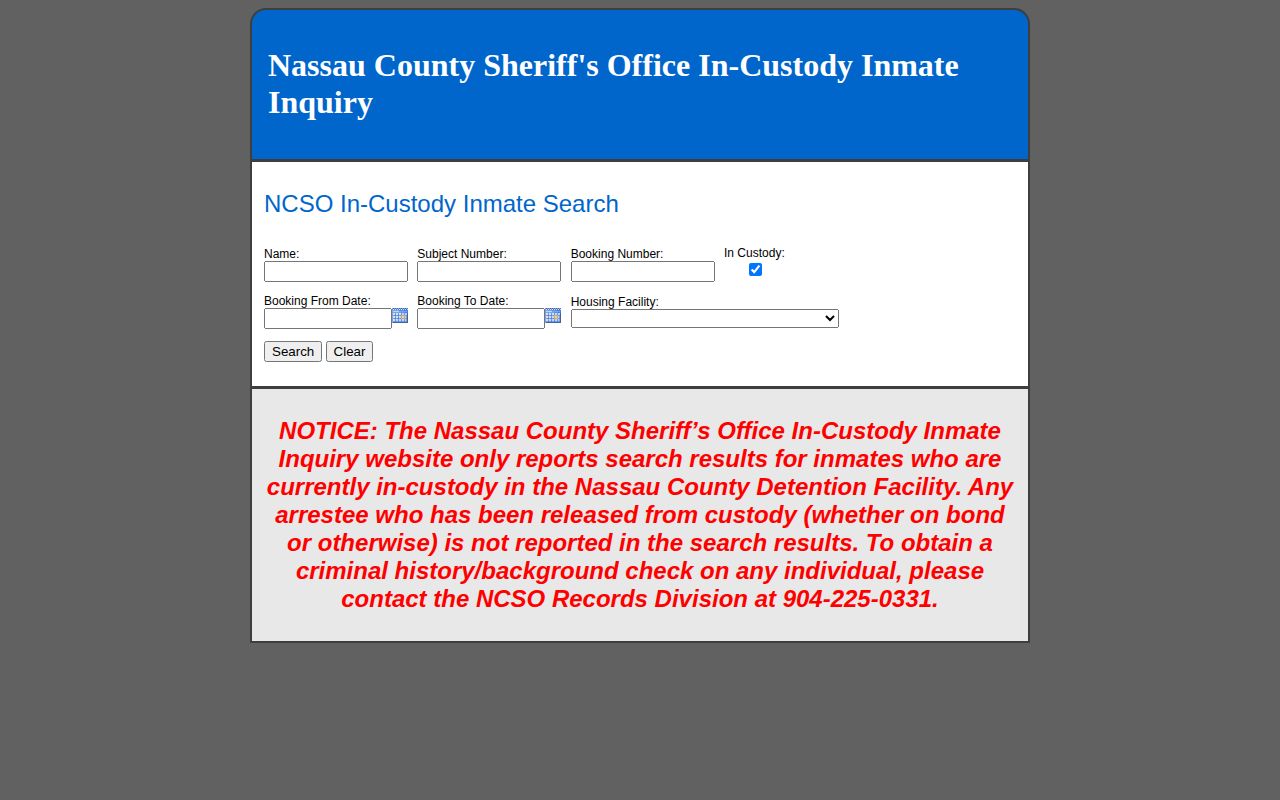
A missing name is therefore a clue, not proof. Use the correct fallback chain:
- Check spelling and identifiers in the NCSO inquiry. A match means the person is currently reported in custody.
- Call booking at (904) 548-4006 or jail information at (904) 548-4002. Ask whether the booking ended and whether the person entered the community or transferred.
- Search the Nassau Clerk's court record for bond, judgment, sentence, dismissal, probation, commitment, or a release order.
- Check Florida VINE against Nassau County for a matched status or alert, while treating it as notification rather than certification.
- Request the actual booking and release event from NCSO when documentary proof is needed.
Roster limit: Booking-date fields filter current bookings. They do not create a 24-hour or 72-hour list of releases.
Nassau FDC Release Search
The FDC Offender Search applies to felony offenders sentenced to state prison or state supervision. It excludes county jail, county probation, and other local supervision. Search with the six-character DC number when known. Otherwise use first and last name prefixes, keep aliases enabled, and compare the photo, descriptors, offense, sentence, and case information before accepting a match.
| Search field | Use | Limit |
|---|---|---|
| DC number | Best state-record identifier | Six-character FDC number, not an NCSO booking number |
| First and last name | Prefix-based person search | Common names and aliases can collide |
| Aliases | Finds other committed names | Still requires record-level matching |
| Status and dates | Shows state custody, release, or supervision history | Can change and may need Central Records confirmation |
The dedicated released record labels an executed event as “Release Date.” A current prison detail may label a projection “Current Release Date,” while Florida law calls the gain-time projection a “tentative release date.” Do not turn either projected label into a completed release. The official released-offender example shows the state format.
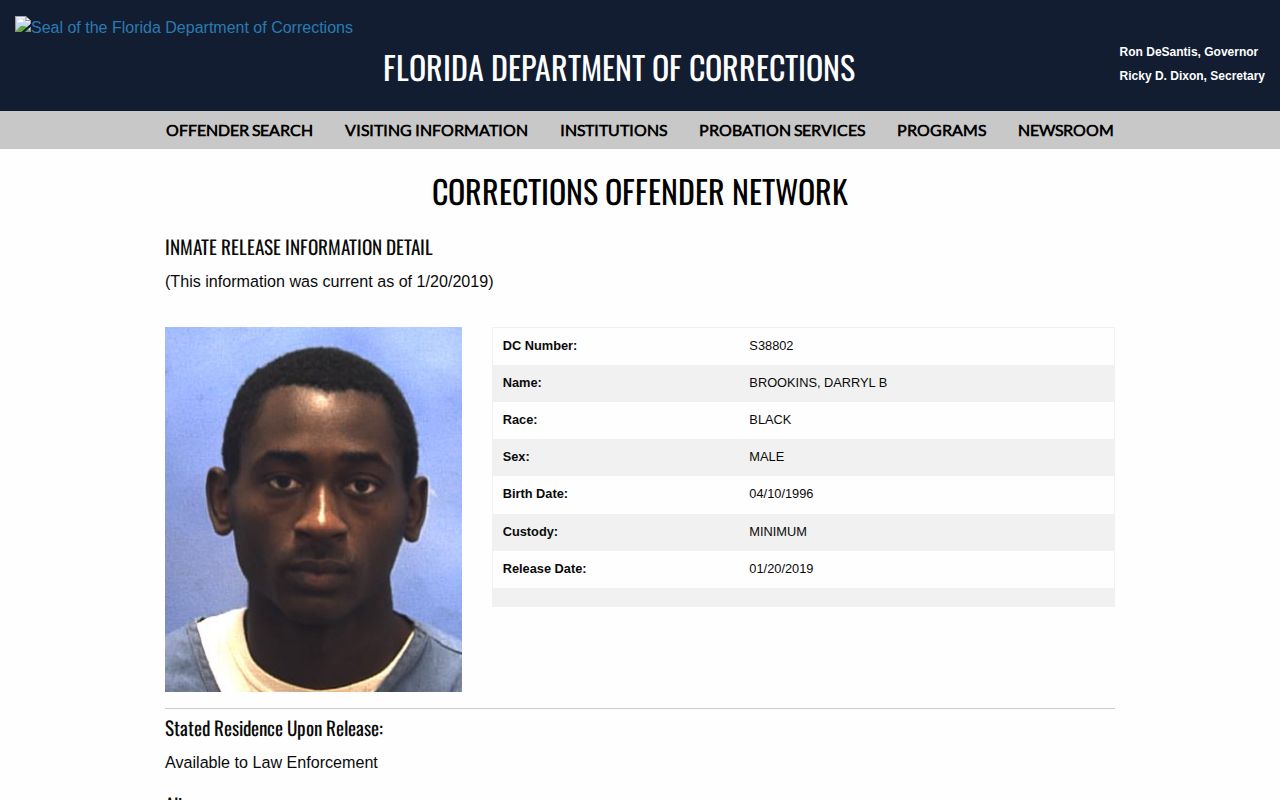
This state result can establish an FDC release history. It cannot prove a Nassau jail release. FDC Central Records at (850) 488-9859 is the discrepancy path, and the supervised-population search should be checked for a term that follows prison.
Nassau Court Release Evidence
The Nassau Clerk Records Search is the durable local path after a name leaves the jail inquiry. Anonymous public viewing is available. Registered access can add search criteria, and the clerk says registration processing can take one to five business days. Search by exact case number when possible, or match a name result with filing dates and identifiers.
Useful entries include first-appearance and bond orders, a posted-bond notice, dismissal, acquittal, time-served sentence, judgment, jail credit, probation, violation, revocation, and termination. A signed order explains legal authority. It does not prove booking staff completed release or that another hold did not apply. Pair the court file with the NCSO event.
Nassau Release Supervision and Reentry
A prison release may lead directly into felony probation, community control, parole, conditional release, or another form of FDC supervision. The FDC supervised-population search and listed office provide the state route. The Nassau post-release supervision record explains how to distinguish those terms and verify the local Yulee office. County misdemeanor supervision may sit outside FDC, so the sentencing order and local provider remain important.
NCSO also lists GED preparation and testing, recovery groups, parenting programs, faith-based reentry mentoring, and chaplain services in the jail. Its 2022 annual report described a state ID card project supported by the Nassau Tax Collector and Inmate Welfare Fund. These sources document local pre-release and reentry efforts, but they do not promise current availability or a specific outcome. Confirm each service with NCSO.
Note: Leaving custody and ending a sentence are separate events when supervision follows release.
Nassau Release Property and ID
NCSO inventories property at intake and reconciles property and money through booking at release. The agency does not publish a deadline for unclaimed property, a clothing process, or a web procedure for correcting an inaccurate release entry. Questions about property closeout or a real-time discrepancy should go to booking. A durable field or document request belongs with Records.
The state ID initiative described in NCSO's 2022 report is a separate documentation path. It should not be assumed available for every person or every release. Ask whether the program is active and whether the specific person took part. A jail ID process also does not replace the need to confirm post-release supervision or a transfer destination.
Nassau ICE Release Transfers
A 2019 NCSO and ICE Warrant Service Officer agreement documents a Nassau workflow in which a scheduled criminal-custody release could become a transfer to ICE. The dated agreement supports the possibility of a handoff, not a claim that every current case follows it. Ask NCSO whether the recorded destination was ICE and verify the present program and person through the receiving agency.
The ICE Online Detainee Locator uses either an A-number and country of birth or biographical information. ICE says it can include current detainees and people released from ICE custody in the prior 60 days. A negative result may reflect age of record, spelling, or scope. “Released from Nassau custody to ICE” is a custodial transfer, not community release.
Nassau Federal Release Transfers
Nassau County's fiscal records include a Sheriff Federal Inmate Fund associated with federal inmates held at the county jail. The building alone therefore does not identify the legal custodian. A federal detainee can disappear from NCSO because of a U.S. Marshals transfer, BOP designation, court release, or another handoff.
The BOP Inmate Locator covers federal prison records from 1982 forward and may show a release date with “Released” or “Not in BOP Custody.” BOP warns that another custodian or supervision may still apply and that sentence recalculation can affect a date. For a pretrial federal detainee not yet in BOP's sentenced-prison system, use NCSO destination information with the federal case clerk or U.S. Marshals route.
Note: Federal physical placement at the Nassau jail does not turn a federal detention record into a county sentence.
Nassau Release Status Channels
The correct channel depends on both the former custodian and the question being asked. A live roster reports present jail custody. A release event records the execution of release or transfer. A court docket explains legal authority. State, federal, immigration, notification, and registry systems each have narrower roles.
| Situation | Best first source | What confirms it |
|---|---|---|
| Still in Nassau jail | NCSO current-custody inquiry | Booking desk for current operational status |
| Released from Nassau jail | NCSO booking and Records | Actual event plus clerk authority |
| Released from state prison | FDC released-offender search | FDC release and supervision records |
| Federal sentence | BOP locator | Federal case and any supervision record |
| Immigration custody | ICE locator or information line | NCSO destination and ICE status |
| Release alert | Florida VINE | Independent custodian check after notification |
| Specialized registrant | FDLE registry | Registration status only, not general custody |
The FDLE registry's “Released, Subject to Registration” filter is narrow. It applies to a person who is no longer confined or supervised but still has a statutory duty to register. It is not a general list of Nassau County released inmates, and other registry statuses may describe people who remain confined or supervised.
Nassau County has three relevant local facilities. The Nassau County Jail & Detention Center is the adult county jail and release-processing point. The Fernandina Beach Police Department Detention Building is a municipal holding and processing site whose adult arrests normally move to NCSO. The NCSO Callahan Sub-Station is a law-enforcement site, not a separate public adult-jail roster. The Nassau jail release record gives the facility-specific contact and confirmation route.